Systematic Transfer Plan
Under developement
Under developement
Full time role
Full time role
10+ screens
10+ screens
30+ days of efforts
30+ days of efforts
Making investments feel understandable!
Making investments feel understandable!
Redesigning the Systematic Transfer Plan (STP) journey of ULIP poloicy to simplify fund transfers and help users invest with confidence.
Redesigning the Systematic Transfer Plan (STP) journey of ULIP poloicy to simplify fund transfers and help users invest with confidence.
Designed to reduce uncertainty and build confidence in financial decisions
Designed to reduce uncertainty and build confidence in financial decisions

The Brief
The Brief
The Brief
A Unit Linked Insurance Plan (ULIP) allows policyholders to invest in multiple market linked funds while providing life insurance coverage. One of its key features is the Systematic Transfer Plan (STP), which automatically moves investments between funds over time to help manage market volatility.
However, the existing STP journey was difficult for users to understand and complete. Complex financial terminology, a fragmented flow, and limited guidance made the feature feel intimidating.
This project focused on redesigning the end-to-end STP experience by improving user guidance, and creating a clearer, step by step journey.
A Unit Linked Insurance Plan (ULIP) allows policyholders to invest in multiple market linked funds while providing life insurance coverage. One of its key features is the Systematic Transfer Plan (STP), which automatically moves investments between funds over time to help manage market volatility.
However, the existing STP journey was difficult for users to understand and complete. Complex financial terminology, a fragmented flow, and limited guidance made the feature feel intimidating.
This project focused on redesigning the end-to-end STP experience by improving user guidance, and creating a clearer, step by step journey.
A Unit Linked Insurance Plan (ULIP) allows policyholders to invest in multiple market linked funds while providing life insurance coverage. One of its key features is the Systematic Transfer Plan (STP), which automatically moves investments between funds over time to help manage market volatility.
However, the existing STP journey was difficult for users to understand and complete. Complex financial terminology, a fragmented flow, and limited guidance made the feature feel intimidating.
This project focused on redesigning the end-to-end STP experience by improving user guidance, and creating a clearer, step by step journey.
When the project was handed over to me, the ask sounded deceptively simple
When the project was handed over to me, the ask sounded deceptively simple
”Redesign the STP flow, simple enough on the surface”
”Redesign the STP flow, simple enough on the surface”
”Redesign the STP flow, simple enough on the surface”

THE REAL CHALLENGE
THE REAL CHALLENGE
The STP feature already existed inside the mobile app, and technically, it worked.
The STP feature already existed inside the mobile app, and technically, it worked.
But...it mostly worked for financially fluent users, who already understood investment behaviour, fund movement, risk, and allocation logic almost instinctively.
But...it mostly worked for financially fluent users, who already understood investment behaviour, fund movement, risk, and allocation logic almost instinctively.
But for everyday users, the experience felt dense, intimidating, and mentally exhausting.
But for everyday users, the experience felt dense, intimidating, and mentally exhausting.
Major usability and business challenges of existing STP journey is, It has...
Major usability and business challenges of existing STP journey is, It has...
High drop offs
~68% users dropped before completing the setup.

High drop offs
~68% users dropped before completing the setup.
High drop offs
~68% users dropped before completing the setup.
Support spikes
The journey created a heavy dependency on customer support after launch.

Support spikes
The journey created a heavy dependency on customer support after launch.
Support spikes
The journey created a heavy dependency on customer support after launch.
AUM risk
Confused users often misunderstood fund performance and exited their policies.

AUM risk
Confused users often misunderstood fund performance and exited their policies.
AUM risk
Confused users often misunderstood fund performance and exited their policies.
That completely changed how I approached the redesign...
That completely changed how I approached the redesign...
That completely changed how I approached the redesign...
Before auditing screens, studying competitors, or mapping user journeys, I intentionally paused all UI thinking and first focused on understanding STP itself.
Before auditing screens, studying competitors, or mapping user journeys, I intentionally paused all UI thinking and first focused on understanding STP itself.
Before auditing screens, studying competitors, or mapping user journeys, I intentionally paused all UI thinking and first focused on understanding STP itself.
I broke down the entire investment movement logic from scratch and understood how STP actually works in the real world.
I broke down the entire investment movement logic from scratch and understood how STP actually works in the real world.
I broke down the entire investment movement logic from scratch and understood how STP actually works in the real world.


Funds
Funds
Funds
Add
amount
Add
amount
Add
amount
Select
Select
Select
AUM
AUM
AUM
Unit
Value
Unit
Value
Unit
Value

So...What even Systematic Transfer Plan (STP) is?
So...What even Systematic Transfer Plan (STP) is?
So...What even Systematic Transfer Plan (STP) is?

Suppose you invest in a ULIP (Insurance) policy, wherein your money is invested across multiple funds.
Suppose you invest in a ULIP (Insurance) policy, wherein your money is invested across multiple funds.

-8.45%
Among those funds, if any fund is performing low, so you want to move money from that fund into high performing funds
Among those funds, if any fund is performing low, so you want to move money from that fund into high performing funds
But, moving the entire amount at once can feel risky; especially in a volatile market
But, moving the entire amount at once can feel risky; especially in a volatile market
That’s where Systematic Transfer Plan comes in.
That’s where Systematic Transfer Plan comes in.
That’s where Systematic Transfer Plan comes in.
Where instead of a one time switch, a fixed amount gets transferred periodically from one fund to one/more funds over time.
Where instead of a one time switch, a fixed amount gets transferred periodically from one fund to one/more funds over time.
Where instead of a one time switch, a fixed amount gets transferred periodically from one fund to one/more funds over time.
FUND 1
FUND 1
FUND 1
FUND 2
FUND 2
FUND 2
FUND 3
FUND 3
FUND 3
Periodic Transfer
Periodic Transfer
Periodic Transfer
SOURCE FUND
SOURCE FUND
SOURCE FUND


LET’S KNOW THE USER
Major focus was on users who are not expert in financial things or investments, so I took a persona accordingly
Major focus was on users who are not expert in financial things or investments, so I took a persona accordingly
Meet Suresh Joshi, 34 yo, software engineer at Bangalore. He has a ULIP. Doesn't know why
Meet Suresh Joshi, 34 yo, software engineer at Bangalore. He has a ULIP. Doesn't know why

A day in Suresh's financial life...
A day in Suresh's financial life...


09:00 AM
Checks his investment portfolio.
HOLDINGS
₹4,90,990
1D returns:
-2.23%

“Markets are down again… should I move my money somewhere safer?”

10:00 AM
Sanjay got to know from colleagues about ULIP fund switching.
01:00 PM

01:00 PM
Opens the insurance app during lunch break.
"Wait, I can move money between funds without withdrawing it?"
Okay..Lets see how STP works

SWITCH OUT?
SWITCH IN?
AUM?
ALLOCATION RATIO?
Why it’s too complicated?

01:05 PM
Tries selecting funds but struggles to understand impact.
"If I move money from here… where exactly is it going?"
01:08 PM
Exits the journey without completing the setup.


Works at
Mid sized IT firm
₹15–20L annual CTC
Invests in
FD, SIP and ULIP
Bought ULIP on agent advice in 2019
Opens insurance app
Maybe twice a year
Only when something feels off
Apps he uses daily
GPay and Grow
Digitally fluent, not finance fluent


Suresh dropped off the journey not because he couldn’t understand the product but because the product failed to understand him.
These were the behavioral patterns, emotional triggers, and usability gaps observed through Suresh’s journey.
Understanding these friction points became important to redesign the experience around how users actually think, hesitate, and make financial decisions.

Cognitive Overload
No Context
Financial Anxiety
Terminology Friction
Blind Choice
Discoverability
Eroded Self confidence
REAL PERSONA INSIGHT
Suresh isn't afraid of making financial decisions. He's afraid of making them wrong, alone, in the dark. The design job isn't to simplify finance it's to make him feel like he's not the only one in the roo


The redesign about making users feel more confident while making financial movement easier to understand.
The biggest shift in the journey was changing the experience from “Configure an STP” to “Understand where your money is going.
The redesign about making users feel more confident while making financial movement easier to understand.
The biggest shift in the journey was changing the experience from “Configure an STP” to “Understand where your money is going.
SOLUTION
SOLUTION

“Okay, I want to transfer my money but in a planned way. so any market fluctuation would not impact my transfer. Let me see where this option is.”
“Okay, I want to transfer my money but in a planned way. so any market fluctuation would not impact my transfer. Let me see where this option is.”
“Okay, I want to transfer my money but in a planned way. so any market fluctuation would not impact my transfer. Let me see where this option is.”
Suresh Joshi (Persona)


All services
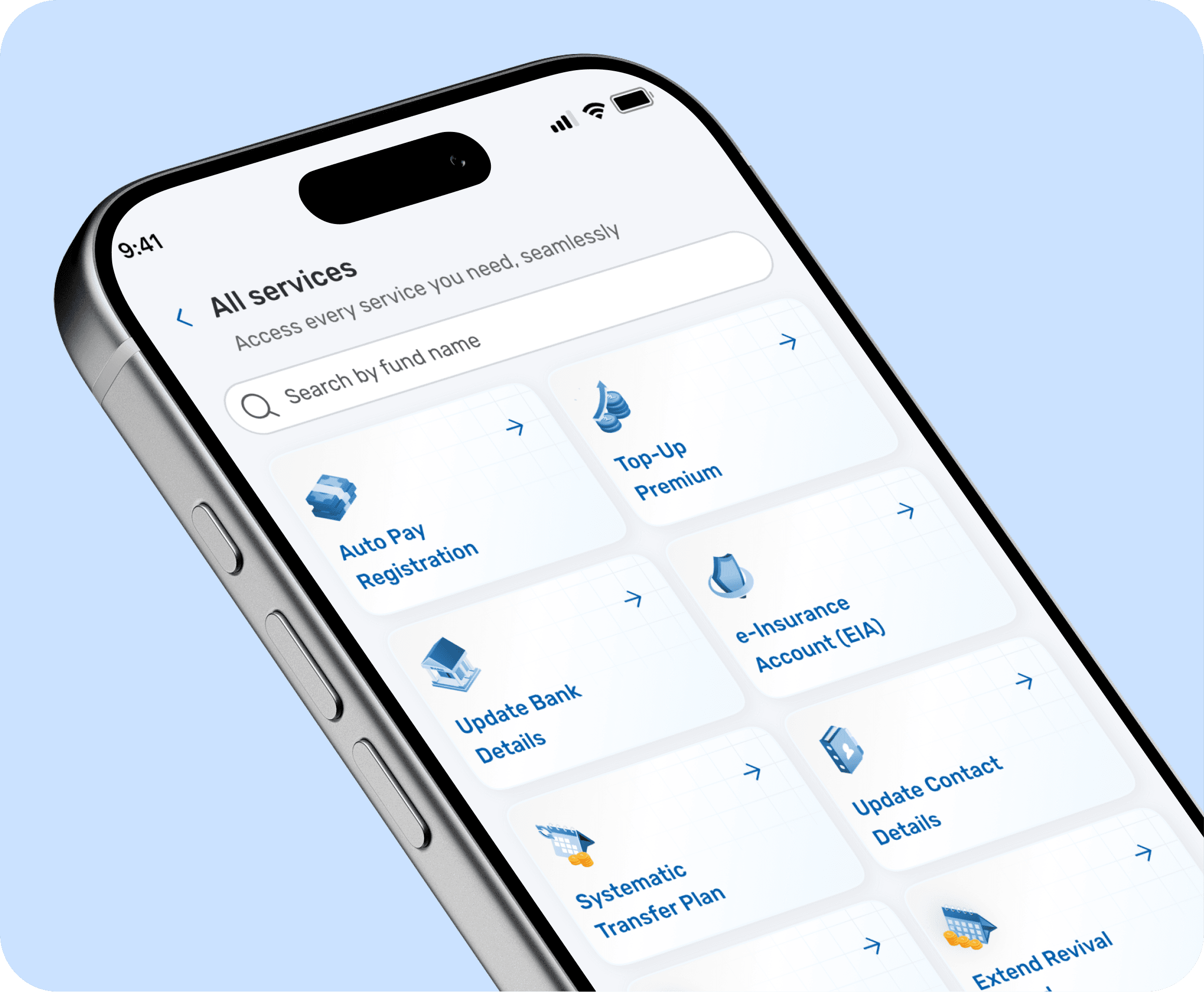
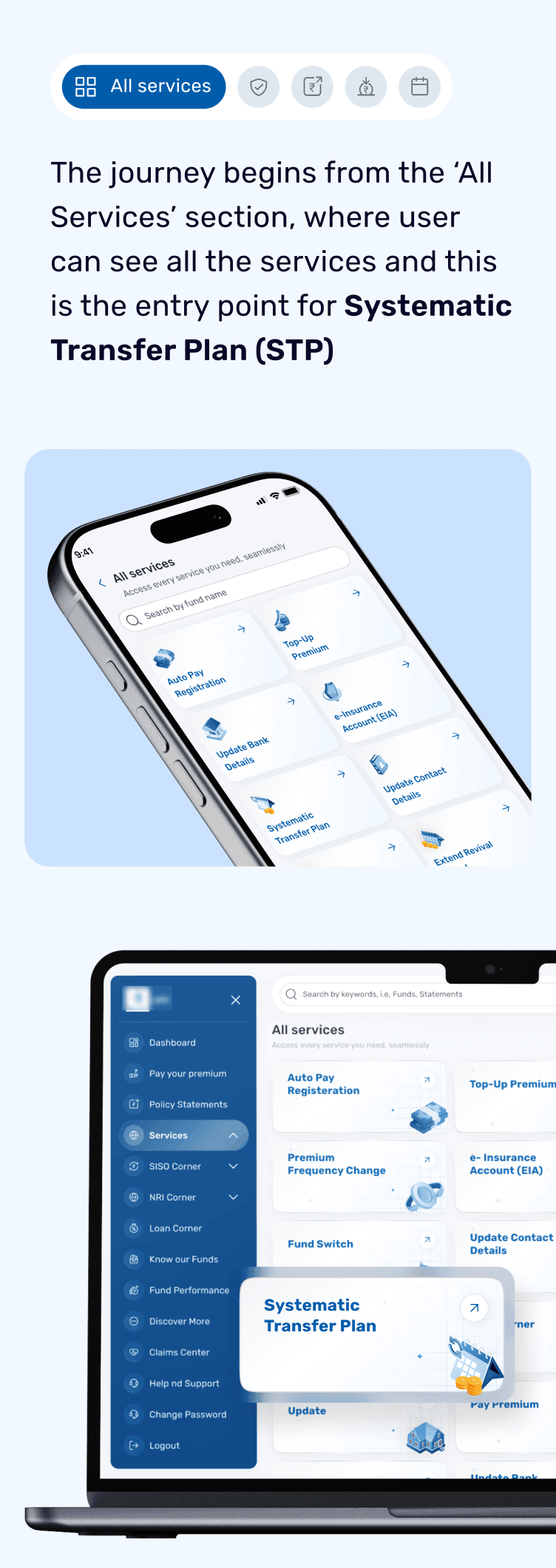
The journey begins from the ‘All Services’ section, where user can see all the services and this is the entry point for Systematic Transfer Plan (STP)
The journey begins from the ‘All Services’ section, where user can see all the services and this is the entry point for Systematic Transfer Plan (STP)

Systematic Transfer Plan
Systematic Transfer Plan


My Policies
Guiding users to choose the right policy first, before starting the STP setup
Guiding users to choose the right policy first, before starting the STP setup
The experience first helps users identify the right policy to begin with. Since many users hold multiple ULIP policies, I designed this step to support quick comparison
The experience first helps users identify the right policy to begin with. Since many users hold multiple ULIP policies, I designed this step to support quick comparison
Fund value
Fund value
₹3,48,989.10
₹3,48,989.10
8.16%
8.16%
“Ohh its nice, It will be easier for me to check on among my multiple policies, which policy should I select for STP”
“Ohh its nice, It will be easier for me to check on among my multiple policies, which policy should I select for STP”

Instead of directly pushing users into financial setup, I introduced a lightweight onboarding modal explaining the 3-step STP journey upfront.
The goal was to create predictability before interaction.

“Ohh its nice, It will be easier for me to check on among my multiple policies, which policy should I select for STP”
“Just 3 simple steps to complete my transfer? That's a relief..!”





Once users enter the STP journey, the first major decision is selecting the fund from which money should be transferred.
Once users enter the STP journey, the first major decision is selecting the fund from which money should be transferred.
Switch out
Understanding where the money moves from?
Understanding where the money moves from?

Instead of overwhelming users with forms immediately, I designed this step to first support exploration and understanding.
Instead of overwhelming users with forms immediately, I designed this step to first support exploration and understanding.
I didn’t want users to immediately see Input fields, Amount entry, Transfer actions before even understanding the fund itself.
I didn’t want users to immediately see Input fields, Amount entry, Transfer actions before even understanding the fund itself.
The left panel acts as a comparison space, while the right panel behaves like a focused workspace for the selected fund.
The left panel acts as a comparison space, while the right panel behaves like a focused workspace for the selected fund.
Once users select a fund, the right panel reveals detailed insights and transfer controls.
Once users select a fund, the right panel reveals detailed insights and transfer controls.
This made the journey feel more guided, less intimidating, easier to focus on while helping users clearly understand the fund before entering the transfer amount.
This made the journey feel more guided, less intimidating, easier to focus on while helping users clearly understand the fund before entering the transfer amount.

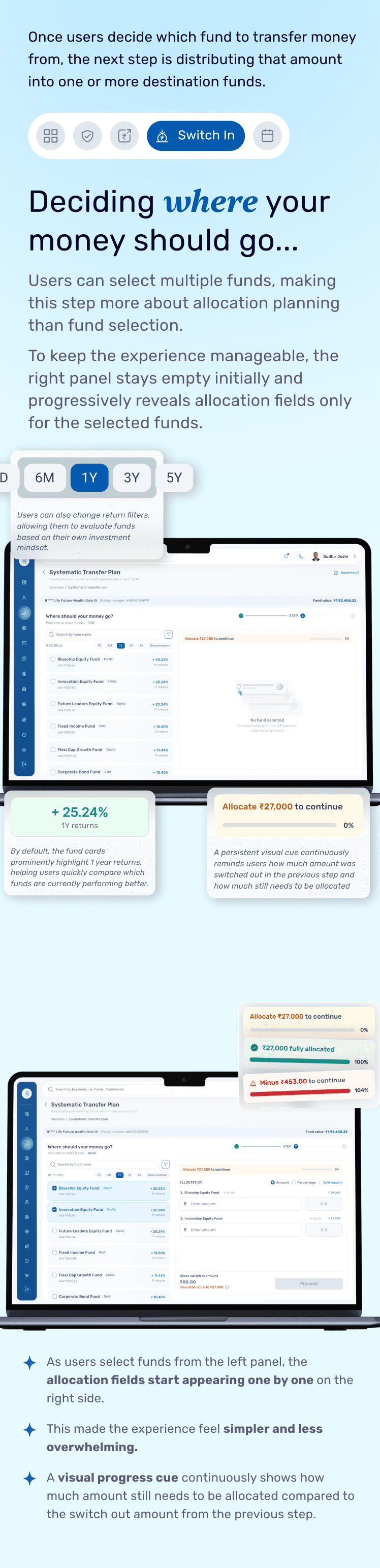
Once users decide which fund to transfer money from, the next step is distributing that amount into one or more destination funds.
Once users decide which fund to transfer money from, the next step is distributing that amount into one or more destination funds.
Switch In
Switch In
Deciding where your money should go...
Deciding where your money should go...
Users can select multiple funds, making this step more about allocation planning than fund selection.
Users can select multiple funds, making this step more about allocation planning than fund selection.
To keep the experience manageable, the right panel stays empty initially and progressively reveals allocation fields only for the selected funds.
To keep the experience manageable, the right panel stays empty initially and progressively reveals allocation fields only for the selected funds.

As users select funds from the left panel, the allocation fields start appearing one by one on the right side.
As users select funds from the left panel, the allocation fields start appearing one by one on the right side.
This made the experience feel simpler and less overwhelming.
This made the experience feel simpler and less overwhelming.
A visual progress cue continuously shows how much amount still needs to be allocated compared to the switch out amount from the previous step.
A visual progress cue continuously shows how much amount still needs to be allocated compared to the switch out amount from the previous step.

After selecting the source and destination funds, the final step focuses on how the transfer should happen over time
Schedule Transfer
Planning the transfer over time

Monthly
Monthly
Weekly
Weekly
Transfer can happen Monthly or Weekly
Transfer can happen Monthly or Weekly
Installments
Installments
End date
End date
Either number of instalments or end date to stop transfer.
Either number of instalments or end date to stop transfer.

Date is selected by default, user can edit it.
Date is selected by default, user can edit it.
Recommended schedules and preselected transfer dates helped reduce decision fatigue while still keeping users in control.
The default 12-month schedule was intentionally suggested to support gradual fund movement during volatile market conditions.
Instead of making users configure everything from scratch, the journey starts with sensible defaults based on safer long term transfer behaviour.
“Now I can actually understand how my money will move over time”
“Now I can actually understand how my money will move over time”



Thank you!
Thank you!
Open to feedback, critique, and discussion on scaling this system further.
Open to feedback, critique, and discussion on scaling this system further.